Dry Van in the USA: how the most popular freight transportation in America works
Views Count :
Post Views:78
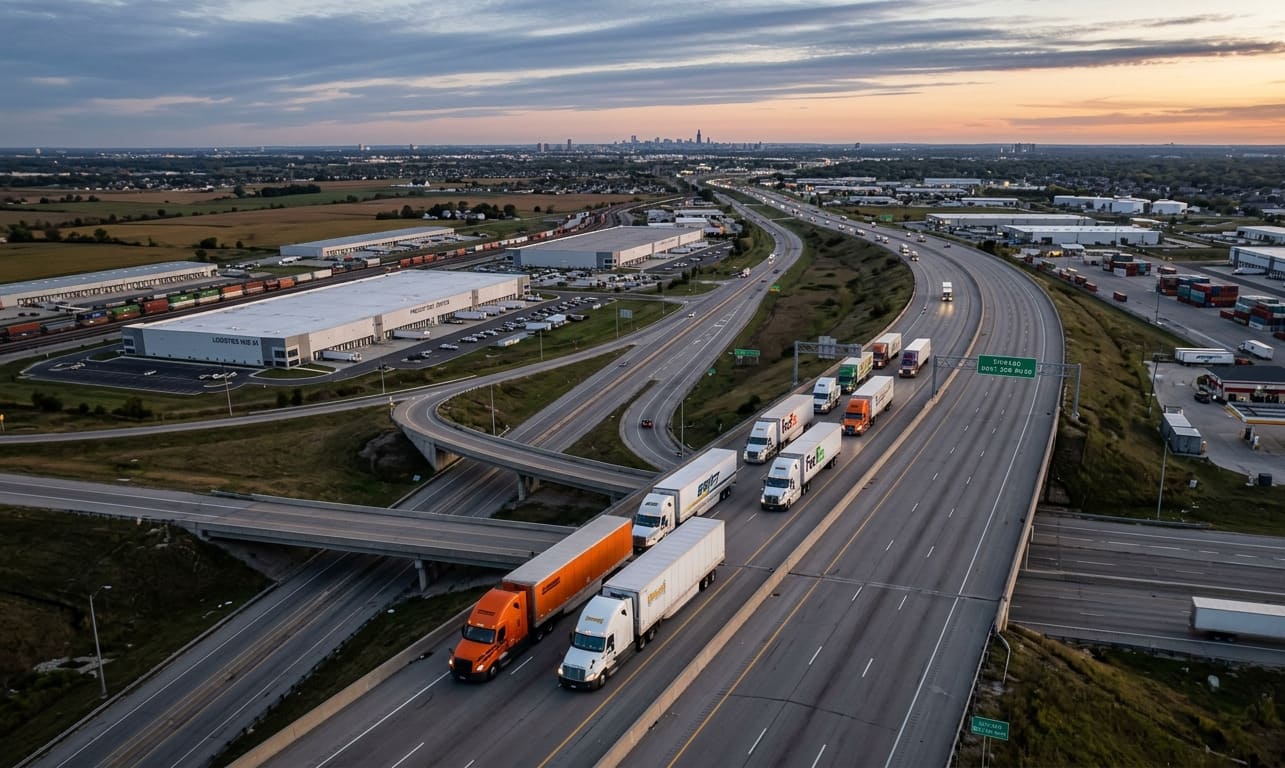
The American auto logistics market has long been considered one of the largest in the world: every day, hundreds of thousands of commercial trailers move across U.S. highways, supplying stores, warehouses, manufacturing facilities, and marketplaces with goods almost without interruption. And if you look more closely at this flow, it becomes clear — the largest share of transportation is handled by Dry Van.
Today, Dry Van transportation in the USA is the actual foundation of the country’s entire domestic logistics system. This format is used for electronics, textiles, furniture, construction materials, retail goods, and most standard commercial cargo. The reason is simple: a closed trailer reliably protects goods from rain, dust, and damage during transport, while the entire operating system has long been optimized down to the smallest details.
For businesses, this means predictability and flexibility. Dry Van easily integrates into large supply chains, fits warehouse logistics for Amazon, Walmart, and other retailers, and enables cargo delivery in the USA without complex technical transport requirements. This is why this trailer type has become the standard for most commercial transportation in North America.
Dry Van: what it is and why this format dominates the U.S. market
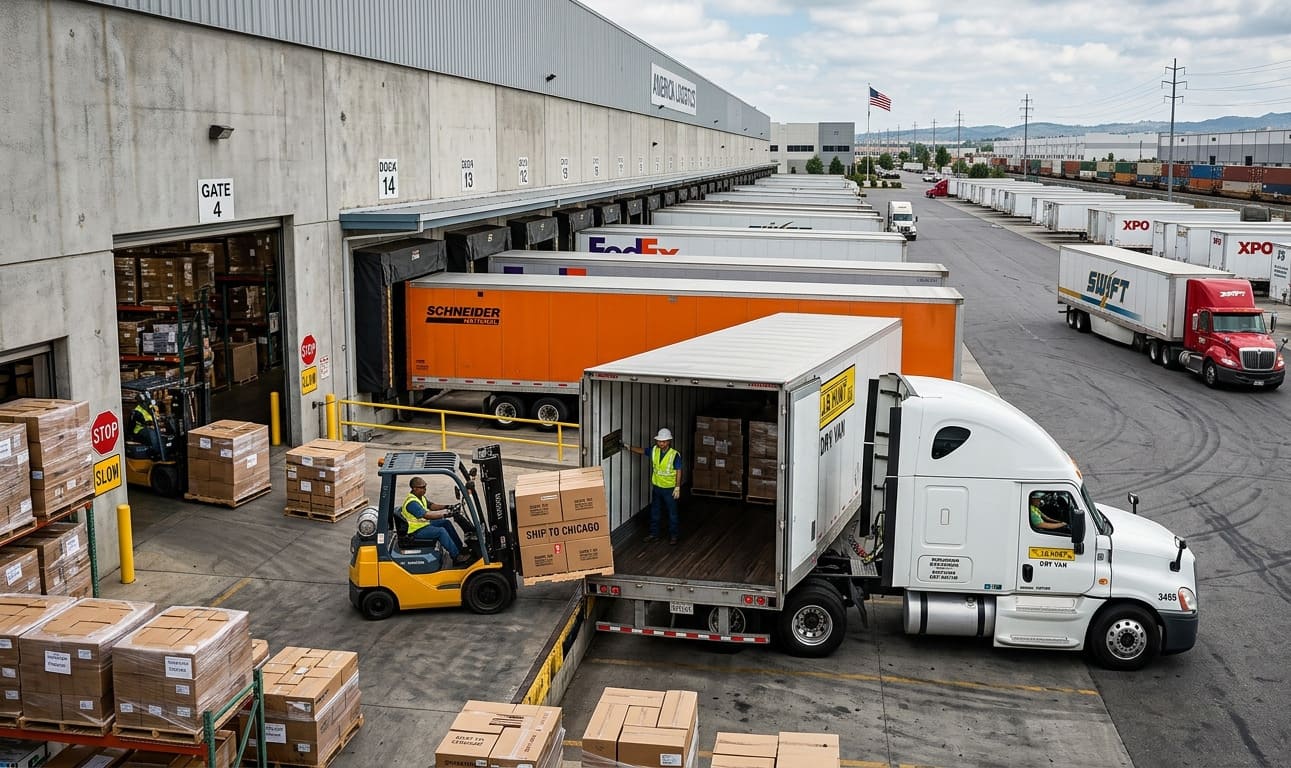
In U.S. logistics, this term refers to a closed freight semi-trailer designed for transporting goods without temperature control. Simply put — it is the classic “box truck” most commonly seen on American highways. This Dry Van trailer has become the backbone of most domestic commercial freight transport in the country.
The term “dry” is not accidental. It literally means that cargo is transported in “dry” conditions, without refrigeration, freezing, or any climate-controlled environment. This format is well-suited for goods that only require basic protection from rain, dust, sunlight, and road debris.
Structurally, a Dry Van truck consists of a tractor unit and an enclosed “Box Trailer” with rigid walls and rear doors. Unlike “flatbed platforms,” where the cargo is exposed, or “reefer trailers” with refrigeration units, Dry Van is considered the most universal solution for standard logistics. This versatility is what made it the “workhorse” of the U.S. freight industry.
Most common Dry Van sizes in the USA
The following trailer types are most commonly used on U.S. roads:
28 ft — short trailers for local or urban deliveries;
48 ft — an older standard for interstate routes;
53-foot trailer — the primary format for retail, FMCG, and warehouse logistics.
Today, 53-foot trailers are used by Amazon, Walmart, Costco, and major distribution centers. The reason is simple: this semi-trailer allows more pallets without axle overload and optimizes trip costs. For carriers, this means better fuel efficiency, and for clients — lower cost per pallet shipped.
What cargo a dry van truck carries in the USA
These trucks are suitable for goods that do not require refrigeration, heating, or humidity control. Most often, this is boxed, palletized, or factory-packed cargo that can be safely loaded through the rear doors. The main requirement is that the cargo must remain stable inside a closed space during transport.
Across the U.S., this method is commonly used to transport:
Electronics and components — provided proper packaging and internal securing inside the trailer;
Furniture and home goods — especially when protection from dust and weather is required;
Clothing, footwear, textiles — large shipments for retailers and distribution centers;
Dry construction materials — mixtures, tools, fasteners, packaging materials;
E-commerce goods — boxes, pallets, and mixed shipments for redistribution.
That is why this method is widely used for deliveries to retail chains, fulfillment centers, and marketplace warehouses. For example, if delivery to Amazon warehouses is required, this format is suitable for most standard goods: shipments can be palletized, labeled, and sent without complex temperature control.
It is also worth mentioning electronics, as it is sensitive to moisture, dust, and rough handling. A closed dry trailer reduces these risks if the goods are properly packaged, secured with straps or “Load Bars,” and have no free movement inside. For the client, this means fewer damaged boxes, dents, and receiving claims.
Which cargo types are not suitable for Dry Van
This format may look universal, but it is not a “one-size-fits-all” trailer. Its main limitation is the lack of temperature control. Inside the trailer, temperatures fluctuate depending on weather conditions, especially on long routes through southern states or during winter in the north. Therefore, some goods should be planned for specialized transport from the start.
The following should not be shipped in a Dry Van:
Cargo requiring temperature control — cosmetics, pharmaceuticals, certain supplements;
Dangerous goods — chemicals, flammable substances, aerosols without proper documentation;
Liquids without proper packaging — cans, barrels, or bottles that may leak during transit;
Oversized cargo — equipment or structures that exceed height, width, or loading constraints.
A common mistake is sending sensitive goods in a standard dry freight trailer because “the distance is short.” For example, a shipment of chocolate or cosmetics can lose its commercial appearance after just a few hours in heat in Arizona or Texas. Savings on trailer type quickly turn into losses, claims, and reshipments.
Pitfalls of Dry Van freight transportation
In reality, most issues in this system arise not on the road, but before the truck even departs.
The first risk is an incorrect “Dock Appointment.” In the U.S., warehouses operate on strict time windows, and if the truck arrives late or early, it may not be accepted immediately. For large networks, this is critical: Amazon, Walmart, and other retailers strictly follow schedules, and missed slots often result in penalties or rescheduling.
The second issue is detention time. If loading or unloading exceeds the agreed timeframe, the carrier may charge detention fees. While this may seem minor on paper, it quickly adds up across multiple trips. That is why it is essential to verify warehouse readiness, dock staffing, and document accuracy in advance.
There are also different loading types:
Live load — the driver waits while cargo is loaded;
Live unload — the driver is present during unloading;
Drop trailer — the trailer is left at the warehouse and picked up later.
Another frequent issue is poor cargo securing inside the trailer. Even if the goods are not fragile, sudden braking can shift boxes and pallets, and the receiving warehouse may reject damaged shipments. In Dry Van logistics, it is not only about the truck but also about cargo preparation: proper palletizing, stretch wrapping, securing, and correct weight distribution.
Logistics company or private carrier: which is better for Dry Van in the USA
In the U.S. market, this service can be organized in two ways: through a broker/3PL or directly via a local carrier.
The first option is a logistics company that selects the truck, coordinates routes, documents, warehouse appointments, and communication with drivers.
The second is a private carrier with their own dry trailer, who handles and executes the shipment independently.
The difference becomes especially noticeable when schedules change, warehouse delays occur, or non-standard requirements arise. One model provides more stability and coordination, the other may offer a lower rate. Below is a basic comparison.
Criteria
Logistics Company (Broker / 3PL)
Private Carrier (Owner Operator)
Process Control
Coordinates all stages
Limited to own trailer only
Delivery Stability
Higher (carrier network)
Depends on one driver
Price
Usually slightly higher due to service
May be lower
Risk of Shipment Disruption
Lower
Higher (illness, breakdowns, delays)
Coverage Area
Across all U.S. states
Limited by driver routes
Documentation Handling
Fully handled by the company
Partially handled by the customer
Flexibility
High (trailer selection, route planning, etc.)
Limited by available resources
Support
Continuous assistance
Minimal
A private driver can be cost-effective for simple routes on familiar lanes when the cargo is standard and timing is not critical.
However, for regular shipments and complex logistics, working through a 3PL is more efficient. In this model, the logistics company G8toUS coordinates transportation, removing operational workload from the client.
How much Dry Van services cost in the USA
The cost of Dry Van freight transportation in the U.S. is not fixed. The same route may have different pricing depending on season, demand, and truck availability. Therefore, rates are calculated per shipment, not as a standard tariff.
Key pricing factors include:
Distance and per-mile rate;
Fuel costs and fuel surcharges;
Seasonality and demand peaks;
Region of loading;
Urgency of shipment;
Empty miles;
Warehouse conditions and dock delays.
The final price is determined only after clarifying details: pickup and delivery points, weight, volume, scheduling requirements, and warehouse constraints.
When logistics works not “on paper” but in real cargo movement
Dry Van became the standard in American freight not because it is the cheapest option, but because it is flexible and universal. One truck can carry different types of goods and quickly adapt to market needs.
However, U.S. logistics operates through strict constraints: time windows, warehouse rules, documentation, weight distribution, and loading types. Therefore, success depends not only on transport but also on process coordination.
For this reason, logistics coordination plays a key role. This is the model used by G8toUS, where transportation is managed as a structured system rather than isolated shipments.
Dry Van transportation in the USA is not just a truck on the road, but part of a complex logistics infrastructure where mistakes are costly and precision saves time and money.
Article written by
Viktor Kravchenko
Founder and CEO of Gate to US. Thanks to many years of experience, Victor implements modern logistics solutions that meet market requirements and individual customer needs.